Posts

Showing posts with the label Science

Sensation and Perception

Image
What is Sensation Sensation is the processes or experiences aroused when a stimulus has excited a receptor or when any of the sense organs are stimulated. What are Receptors Receptors are specialized cells in the sense organs, muscles, skin and joints that detect physical and chemical changes and translates these events into impulses and passes the electrical signals to connecting neurons . What is Stimulus Stimulus (or stimuli) is a form of physical energy inside or outside the body which initiates activity. The signal that travels up to the spinal cord until it reaches its receiving area in the cortex, with different receiving areas for different sensory modalities (electric signals results in sensory experience). Thus, when we experience touch, the experience is occurring in our brain , into in our skin. The electrical impulses on our brain that directly mediate the experience of touch are themselves caused by electrical impulses in touch receptors located in the skin...
Peripheral Nervous System (PNS)

Image
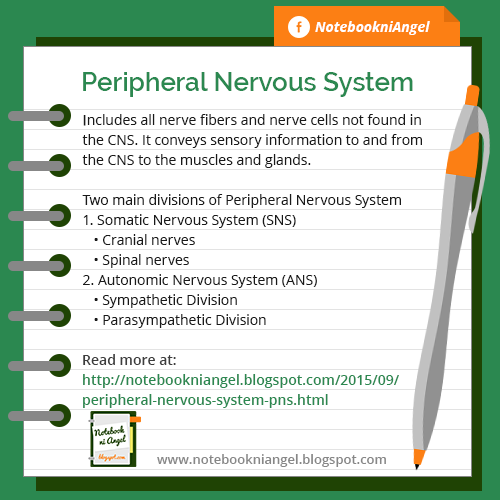
Peripheral Nervous System includes all nerve fibers and nerve cells not found in the CNS (spinal and cranial nerves). It conveys sensory information to and from the CNS to the muscles and glands. Two main divisions of Peripheral Nervous System 1. Somatic Nervous System (SNS) Somatic Nervous System is composed of 43 major pairs of nerves , which includes all the sensory systems and the motor nerves that activates the skeletal muscles responsible for movements. It receives sensory information from the sensory organs and controls the movements of the skeletal muscles. It comprises all voluntary and conscious movements. Cranial nerves (12 pairs) serve the sensory and motor functions of the head and neck region. Spinal nerves (31 pairs) serves the chest, trunk and extremities. Spinal nerves have sensory nevers that give rise to skin sensations and motor nerves involved in the movements of arms, legs, and portions of the trunk. (8 cervical, 12 thoracic, 5 lumbar, 5 sacral, and ...

Biology: Cortical Areas of the Brain

Image
Visual Area is located at the back of each occipital lobes. It analyzes, integrates, and translates into sight impulses projected from our visual receptors. Auditory Area is located at the surface of the temporal lobe. It is involved in the analysis of complex auditory signals and temporal patterning of sounds. Somesthic/Body Sense Area is located in the parietal lobe. It receives impulses from receptors in the skin, musclesm tendons and joints, thus causing us to experience heat, cold and pressure. Motor Area lies in front of the central fissure. It controls voluntary movements of the body and muscles movements Broca's Area is located below the motor area. It is also called the speech-motor area. Integrates and coordinates our speech. Association Area connects with the different parts of the brain. It may mediate complex functions associated with memory, perception, judgment and language. It has a special importance in integrating and coordinating thinking and problem ...

Biology: The Lobes of the Brain

Image
The lobes of the brain are the parts of the cerebrum. 1. Frontal lobe (front) In the human brain, the precentral gyrus and the related costical tissue that folds into the central sulcus comprise the primary motor cortex whic controls voluntary movements of specific body parts associated with areas of the gyrus. 2. Occipital lobe (back) The smalles of four lobes of the brain, the occipital lobe is located in the rearmost portion of the skull. The first functional area is the primary visual cortex. It contains a low-level description of the local orientation, spatial-frequency and color properties within small receptive fields. Primary visual cortex projects to the occipital areas of the ventral stream (visual area 2 and visual area 4) and the occipital areas of the dorsal stream - visual area V3, visual area MT (v5) an visual area DP. 3. Parietal lobe (top) The parietal lobe integrates sensory information from different modalities, particularly determining spatial sense an...

Science: Relationship between Electricity and Magnetism

Relationship between Electricity and Magnetism 1. When a current passes through a coil of wire, it generates a magnetic field along its axis. This was discovered by Hans Christian Dersted 2. If a loop of wire is moved through a magnetic field, a current is induced in the wire (ex. transformer, generator). Discovered by Michael Faraday The magnet, in the ancient times, was called lodestone .

Science: Law of Conservation of Charges

Law of Conservation of Charges By Benjamin Franklin  In an isolated system, the total charge is conserved.  Materials can acquire charges when/through: Friction/rubbing (static electricity)  Placed near/on contact with a charged body  Induction, that produces a charge when there is a redistribution of charges  Ionization, the formation of cation (+) and anion (-)

Science: Biology - Mechanism of Organism Evolution

Mechanism of Organism Evolution variation and natural selection genetic drift (migration) - accidental changes in frequency of genes adaptive radiation - rapid multiplication of related species each with specializations allopatric speciation - developments of new species as a result of geograpical isolation which prevents interbreeding mutation - alteration or change of DNA

Science: Biology - Darwin’s Theory of Natural Selection

Darwin’s Theory of Natural Selection Origin of “species” book, all organisms have the tendency to overproduce in reproduction; however, the total population seeme to remain about the approximate number; hence, competition exists; survival of the fittest . species have the ability to produce large number of offsprings resources of the natural world is limited organisms have to compete no two individuals are exactly alike organisms that have survived and produced offspring are those that inherited beneficial traits for survival

Science: Biology - Geologic Time Scale by Arthur Holmes 1913

Biology - Geologic Time Scale by Arthur Holmes 1913 Cenozoic Quarternary - human civilizations Tertiary - age of mammals Mesozoic Cretaceous - last of the dinosaurs Jurrasic - dinosaurs abundant Triassic - first mamals and dinousaurs Paleozoic Permian - expansion of reptiles Carboniferous - age of amphibians Devonians - age of fishes Silurian - few arthropods Ordovician - first vertebrates Cambriam - marine invertebrates Precambriam primitive marine life

Science: Biology - Evidences of Evolution

Fossils - most common fossil impressions left in the sedimentary rocks; fossils may preserve in glaciers[remnants] Structural similarities Vestigial organs - small and incomplete organs that have no apparent function [example: coccyx or tails bones of human] Evidences from embryology Genetics and Biochemistry

Science: Central Nervous System

Image
Central Nervous System – contains the brain and the spinal cord. It serves to connect the sensory and motor fibers within the nervous system thus considered as the "integrating center" for all behavior and bodily functions. Spinal Cord – is the large rope-like segment of nerve tissue extending down the vertebral column, which is approximately as thick as a person’s little finger. Its principal function is to distribute motor fibers to the effector organs of the body and to collect somato-sensory information to be passed on to the brain. Spinal cord is 2/3 as long as the vertebral column and the rest is spinal roots composed of caudal equina. Brain – has an average weight of 3 lbs. and contrains at least 15 billion nerve cells called neurons Major Parts of the Brain   1. Hindbrain Closest to the spinal cord It performs a series of reflex actions such as blinking of the eye and some processes like breathing, heart rate and blood pressure. Parts of Hindbrain ...

Components of the Nervous System - Neurons

Image
What is Neuron/Nerve Cell The basic structural unit or building block of the nervous system The smallest nerve cell is less than a millimeter in size while the largest may be more than a meter in length Nerve cell holds the secret how the brain works Nerve cell has two specialized functions: [1] to receive signal [2] the longer extension is for transmitting signals Acethylcholine – is a neurotransmitter or chemical substance that travels across synaptic gap, stimulates the next neuron, carrying the impulse from one neuron to another Glial cells – are non-neural cells that hold the neurons in place Myelin Sheath – is the covering on the axons of neurons, which insulate them, making the transmission of impulses faster Parts of a Neuron Dendrites – receive impulses and carry them toward the cell bodies. These are short branches of fibers branching out like roots from the cell body Axon – carries impulses away from the cell body toward other neurons. These are...

Science: Laws of Motion

Image
Law of Inertia The resistance to change in motion Law of Acceleration Directly proportional with force and inversely proportional with mass Formula: a=F/m Law of Interaction For every action, there is an equal and opposite reaction

Science: Organic Compounds

Image
Protein Most abundant organic compound Fundamental structural and functional frameworks of the cell’s protoplasm Kinds: Structural/Fibrous protein – build and repair body cell tissues Globular/Enzymatic protein – biological catalyst in almost every chemical reaction Nucleic acid DNA and RNA Carbohydrates Chief energy source Backbone of molecules When combined with protein, they form glycoproteins and proteoglycans Classifications: Monosaccharide – simple sugar which serves as building blocks for more complex forms like glucose, fructose, galactose Disaccharides – formed by chemical combination of 2 monosaccharides but with removal of water molecules (like maltose, sucrose, lactose) Polysaccharide – series of monosaccharides Starch – serves as units of glucose Glycogen – stored carbohydrates found in animals Cellulose – insoluble carbohydrate; abundant in the tough outer wall of plant cells Chitin – exoskeleton of animals Lipids Fats and oils Ser...

Science: Biology - Manifestations of Life

Image
Science: Biology - Manifestations of Life Life - is a complex and dynamic system governed by biological laws and principles Manifestations of Life Defined Organization have cells, turn to tissues, to organs, to organ systems, and to organisms  Metabolism anabolism - absorption and growth catabolism - releasing of energy Development and Growth single repeatedly divided and progressed  Reproduction replication/perpetuate their own child Types of reproduction: asexual - reproduction without the involvement of sex cells  sexual - reproduction with gametes or sex cells  external fertilization [example: frogs and fish]  internal fertilization other organisms  Responsiveness capacity to react or response to stimuli or the irritability  stimuli - [light, heat, gravity, chemicals tough and sound]  Genetic Control   DNA - genes which controls all the manifestations

Science: Types of Forces

Image
There are four types of forces: Gravitational Electromagnetic Weak Nuclear Strong Nuclear

Science: Motion and Laws of Motion

Image
Science: Motion Motion is an act of changing position with respect to a reference point. It can be measured by: speed (scalar quantity) – m/s, km/hr, mi/s (magnitude)  velocity (vector quantity) – m/s eastward (magnitude direction)  acceleration – m/s 2 , km/hr 2 Laws of Motion Law of Inertia The resistance to change in motion Law of Acceleration directly proportional with force and inversely proportional with mass; a=F/m Law of Interaction for every action, there is equal / opposite reaction Law of Universal Gravitation G=6.67 x 10 -11 F=GM 1 M 2 /d 2 W=mg

Science: Astronomers and their Contributions

Image
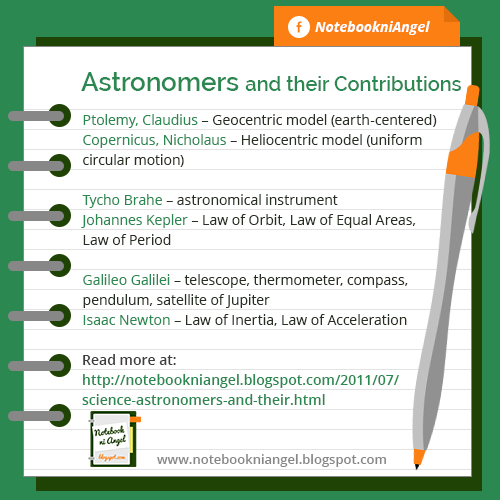
Science: Astronomers and their Contributions Ptolemy, Claudius – Geocentric model (earth-centered) Copernicus, Nicholaus – Heliocentric model (uniform circular motion) Tycho Brahe – astronomical instrument Johannes Kepler – Law of Orbit, Law of Equal Areas, Law of Period Galileo Galilei – telescope, thermometer, compass, pendulum, satellite of Jupiter Isaac Newton – Law of Inertia, Law of Acceleration

Science: Measurement

Image
Measurement is a process of comparing unknown quantity with a standard. (7) Seven Fundamental Quantities 1. length – meter 2. mass – kilogram 3. time – seconds 4. temperature – Kelvin 5. amount of substance – mole 6. electric current – ampere 7. luminous – candela

Science: Scientific Method

Image
The Scientific Method Identify the problem Observation Senses (quality) Measure (quantify) Gather data (table, chart, graph, diagram) Formulate the Hypothesis (wise guess) Experiment Independent variable Dependent variable Interpret Draw Conclusion Recommendation/Application