Posts

Showing posts with the label Biology

Sensation and Perception

Image
What is Sensation Sensation is the processes or experiences aroused when a stimulus has excited a receptor or when any of the sense organs are stimulated. What are Receptors Receptors are specialized cells in the sense organs, muscles, skin and joints that detect physical and chemical changes and translates these events into impulses and passes the electrical signals to connecting neurons . What is Stimulus Stimulus (or stimuli) is a form of physical energy inside or outside the body which initiates activity. The signal that travels up to the spinal cord until it reaches its receiving area in the cortex, with different receiving areas for different sensory modalities (electric signals results in sensory experience). Thus, when we experience touch, the experience is occurring in our brain , into in our skin. The electrical impulses on our brain that directly mediate the experience of touch are themselves caused by electrical impulses in touch receptors located in the skin...
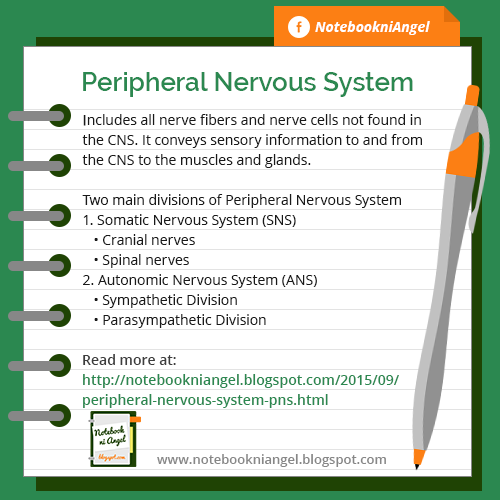
Peripheral Nervous System (PNS)

Image
Peripheral Nervous System includes all nerve fibers and nerve cells not found in the CNS (spinal and cranial nerves). It conveys sensory information to and from the CNS to the muscles and glands. Two main divisions of Peripheral Nervous System 1. Somatic Nervous System (SNS) Somatic Nervous System is composed of 43 major pairs of nerves , which includes all the sensory systems and the motor nerves that activates the skeletal muscles responsible for movements. It receives sensory information from the sensory organs and controls the movements of the skeletal muscles. It comprises all voluntary and conscious movements. Cranial nerves (12 pairs) serve the sensory and motor functions of the head and neck region. Spinal nerves (31 pairs) serves the chest, trunk and extremities. Spinal nerves have sensory nevers that give rise to skin sensations and motor nerves involved in the movements of arms, legs, and portions of the trunk. (8 cervical, 12 thoracic, 5 lumbar, 5 sacral, and ...

Biology: Cortical Areas of the Brain

Image
Visual Area is located at the back of each occipital lobes. It analyzes, integrates, and translates into sight impulses projected from our visual receptors. Auditory Area is located at the surface of the temporal lobe. It is involved in the analysis of complex auditory signals and temporal patterning of sounds. Somesthic/Body Sense Area is located in the parietal lobe. It receives impulses from receptors in the skin, musclesm tendons and joints, thus causing us to experience heat, cold and pressure. Motor Area lies in front of the central fissure. It controls voluntary movements of the body and muscles movements Broca's Area is located below the motor area. It is also called the speech-motor area. Integrates and coordinates our speech. Association Area connects with the different parts of the brain. It may mediate complex functions associated with memory, perception, judgment and language. It has a special importance in integrating and coordinating thinking and problem ...

Biology: The Lobes of the Brain

Image
The lobes of the brain are the parts of the cerebrum. 1. Frontal lobe (front) In the human brain, the precentral gyrus and the related costical tissue that folds into the central sulcus comprise the primary motor cortex whic controls voluntary movements of specific body parts associated with areas of the gyrus. 2. Occipital lobe (back) The smalles of four lobes of the brain, the occipital lobe is located in the rearmost portion of the skull. The first functional area is the primary visual cortex. It contains a low-level description of the local orientation, spatial-frequency and color properties within small receptive fields. Primary visual cortex projects to the occipital areas of the ventral stream (visual area 2 and visual area 4) and the occipital areas of the dorsal stream - visual area V3, visual area MT (v5) an visual area DP. 3. Parietal lobe (top) The parietal lobe integrates sensory information from different modalities, particularly determining spatial sense an...

Psychology: Roles of Genes

Image
The genes uses a chemical alphabet to write instructions for the development of brain and body and the manufacturer or chemicals that affect mental health, learning, emotions, personality traits and everything we do. What is gene? Chains of chemicals arranged like rungs on a twisting ladder There are about 20,000 to 25,000 genes that contain chemical instructions equal to about 300,000 pages of typed instructions (IHGSC, 2004) The chemical instructions program the development of millions of individual parts into a complex body or brain.

Science: Organic Compounds

Image
Protein Most abundant organic compound Fundamental structural and functional frameworks of the cell’s protoplasm Kinds: Structural/Fibrous protein – build and repair body cell tissues Globular/Enzymatic protein – biological catalyst in almost every chemical reaction Nucleic acid DNA and RNA Carbohydrates Chief energy source Backbone of molecules When combined with protein, they form glycoproteins and proteoglycans Classifications: Monosaccharide – simple sugar which serves as building blocks for more complex forms like glucose, fructose, galactose Disaccharides – formed by chemical combination of 2 monosaccharides but with removal of water molecules (like maltose, sucrose, lactose) Polysaccharide – series of monosaccharides Starch – serves as units of glucose Glycogen – stored carbohydrates found in animals Cellulose – insoluble carbohydrate; abundant in the tough outer wall of plant cells Chitin – exoskeleton of animals Lipids Fats and oils Ser...