Posts

What is Lean Six Sigma?

Image
Lean   Six Sigma  is a process improvement method. Six Sigma  reduces defects by effectively solving problems and reduces variation to produce consistent satisfactory products or services. On the other hand,  Lean  increases speed and efficiency of processes by reducing wastes and maximizing flow. These methodical approaches in workplaces create value for the customer that can result in increased evenue, reduced costs, greater customer satisfaction, and improved work environment. Benefits of using Lean Six Sigma Method Improves Efficiency / Effectiveness Lean Six Sigma methods can help you create effective processes that will maximize your business' resources and manpower Reduces Costs Less defects can save your business from spending money (in workforce, materials, equipment) in re-processing or solving the defects Increases Revenue / Profit Lean Six Sigma enables your business to do more with less through improving inefficient processes and ...

S.M.A.R.T. | 5 Pointers in Setting Goals

Image
Last time, we learn about the steps to achieve our goals, and just as promised, we will dig into it a bit more. Today, I'll share with you the acronym  S.M.A.R.T.  which stands for the 5 pointers in goal setting. We can use this pointers to assess our plan and capabilities in achieving our goals. This tool can be helpful not only in workplaces, but also for personal aspirations. SPECIFIC Do you know exactly what you want to accomplish with all the details? Does 'increase product sales' to vague? Of course, it is. When setting a goal, we should be specific and detailed as much as possible. So instead of saying 'increase product sales,' aim to be particular with its details — what products should increase sales, why it should increase its sales? Let's say that our goal now is to increase the product sales of shirts with printed quotes. The store haven't sold any shirts of this kind since the last two months. Now you are going to plan on how to...

8 Types of Wastes in Work Process

Image
Waste  is any step or movement in a process that does not add any value in order to complete the process successfully. When waste is removed, only the essential and required steps to deliver a product or service remain in the process, thus, maximizing the flow. Defect Product/service/output that is out of specification and needs to be corrected or reprocessed Overproduction Producing too much before it is ready to be sold Waiting Time wasted while waiting for the next step in a process Time wasted while waiting for the previous step to be completed Waiting for parts, instructions, details or equipments Non-utilized Talent Employee's underutilized skills and knowledge Transportation Unnecessary movements of products and materials from one location/process to another Inventory Excess materials not being processed  Motion Unnecessary movements by people, info or equipment due to workspace layout, ergonomic issues, or searching for misplaced items ...

How to Get Recognition at Work

Image
Sometimes, even when you consistently work hard, people can often overlook your efforts. You might have helped a colleague in a difficult project, presented a successful proposal, or came up with a great idea and yet you received no praise, appreciation, or recognition for your hard work. We've all been there at some point. You might have considered talking to your supervisor about it. But the problem is, it's very disappointing when you have to ask for recognition yourself. It might seem like you're whining or being too proud of yourself if you make a direct request. Recognition is supposed to be sincere  — but how can we get the recognition we deserve at work without demanding it? Why Should We Strive on Getting Noticed at Work? If colleagues overlooked your hard work, you might lost the opportunities to be considered for new projects, responsibilities, awards, and worse, promotions. Here are some tips and strategies we can do to get noticed in our workplace, a...

4 Steps in Achieving Your Goals

Image
We've all been there — we all tried to set out goals, start the journey, but somehow lost along the way or get demotivated before we even reach it. Sometimes, we fail to achieve our goals because we fail to plan them ahead. We don't clearly set how we are supposed to achieve that, so when we are faced with obstacles or distractions, we tend to give up and change our minds. Today, I share with you four simple steps in achieving our dreams and goals. It's not enough to aim it, you must hit it. 1. What do you want? Define your goals. Write it down and have a clear idea of what you really want to achieve. In order to stay motivated in pursuing your goals, you have to be regularly aware of it, so checking your notes and list will definitely be a big help. 2. Why do you want it? For every goal, there is a good reason or motive . Whether it is for personal, family, or career purposes, goals should be something that is realistic and can have a good impact and improveme...

Sensation and Perception

Image
What is Sensation Sensation is the processes or experiences aroused when a stimulus has excited a receptor or when any of the sense organs are stimulated. What are Receptors Receptors are specialized cells in the sense organs, muscles, skin and joints that detect physical and chemical changes and translates these events into impulses and passes the electrical signals to connecting neurons . What is Stimulus Stimulus (or stimuli) is a form of physical energy inside or outside the body which initiates activity. The signal that travels up to the spinal cord until it reaches its receiving area in the cortex, with different receiving areas for different sensory modalities (electric signals results in sensory experience). Thus, when we experience touch, the experience is occurring in our brain , into in our skin. The electrical impulses on our brain that directly mediate the experience of touch are themselves caused by electrical impulses in touch receptors located in the skin...

Peripheral Nervous System (PNS)

Image
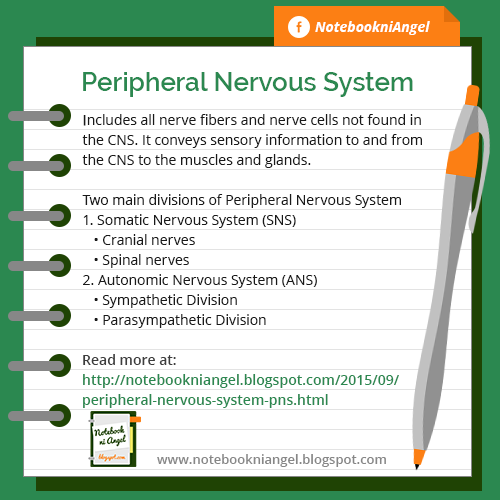
Peripheral Nervous System includes all nerve fibers and nerve cells not found in the CNS (spinal and cranial nerves). It conveys sensory information to and from the CNS to the muscles and glands. Two main divisions of Peripheral Nervous System 1. Somatic Nervous System (SNS) Somatic Nervous System is composed of 43 major pairs of nerves , which includes all the sensory systems and the motor nerves that activates the skeletal muscles responsible for movements. It receives sensory information from the sensory organs and controls the movements of the skeletal muscles. It comprises all voluntary and conscious movements. Cranial nerves (12 pairs) serve the sensory and motor functions of the head and neck region. Spinal nerves (31 pairs) serves the chest, trunk and extremities. Spinal nerves have sensory nevers that give rise to skin sensations and motor nerves involved in the movements of arms, legs, and portions of the trunk. (8 cervical, 12 thoracic, 5 lumbar, 5 sacral, and ...